

Minister's Opening Address at the Commonwealth Law Ministers Meeting (CLMM) 2026 Side Event “The United Nations Convention on International Settlement Agreements Resulting from Mediation – An Anchor in the Storm”
12 Feb 2026 Posted in Speeches
1. Good afternoon to the Assistant Secretary General (“ASG”) of the Commonwealth, Honourable Ministers, Excellencies, distinguished delegates, colleagues, ladies and gentlemen.
2. It is a real pleasure to be here. This is my first Commonwealth Law Ministers Meeting (“CLMM”), and also my first time in Fiji. It has been a fantastic platform for us to come together as a Commonwealth, deepening our legal cooperation in so many important areas. But I feel also particularly important is the opportunity to build networks and camaraderie with all of you as my fellow Commonwealth law ministers and all those involved in the service of law in your countries.
3. I want to also take the opportunity to thank our gracious host – the Government and the people of Fiji – as well as the team from the Commonwealth Secretariat, for the warm welcome and making this year’s CLMM a real resounding success.
4. Let me start by saying a few words about Singapore and Fiji, because we share more than just a few common interests. In the interest of time, I’ll mention two. First, we love our rugby, but that is where the similarities end, because Fiji is a world champion, Singapore, well, we just love our rugby. In fact, the Flying Fijians – as Fiji’s fabled Rugby Sevens team is known – is very well known in Singapore. They had a dominant and commanding performance at the recent HSBC Sevens in Singapore about two weekends ago. They were successful, not just this year, but also the year before that. Theirs is a story of resilience. At the Rugby Sevens, the finals took place between Fiji and France. No disrespect to France, but at halftime, the Fijians were 12 points behind. They caught up in the second half, and won the match to take the championship. That is resilience. I speak a lot about sports, because in my previous hat, before I became the Law Minister, I was the Sports Minister. I enjoy sports, and I can see the qualities and the characteristics of someone who takes part in sport in almost every profession that we see, and it includes the law. My congratulations to Fiji for yet another rugby trophy, putting it in the hands of the Commonwealth. Singapore has also taken the opportunity to offer our Singapore Sports Hub at Kallang to be Fiji’s home away from home. We have said to our Fiji counterparts, every time you want to play outside of Fiji, look at Singapore as your home away from home.
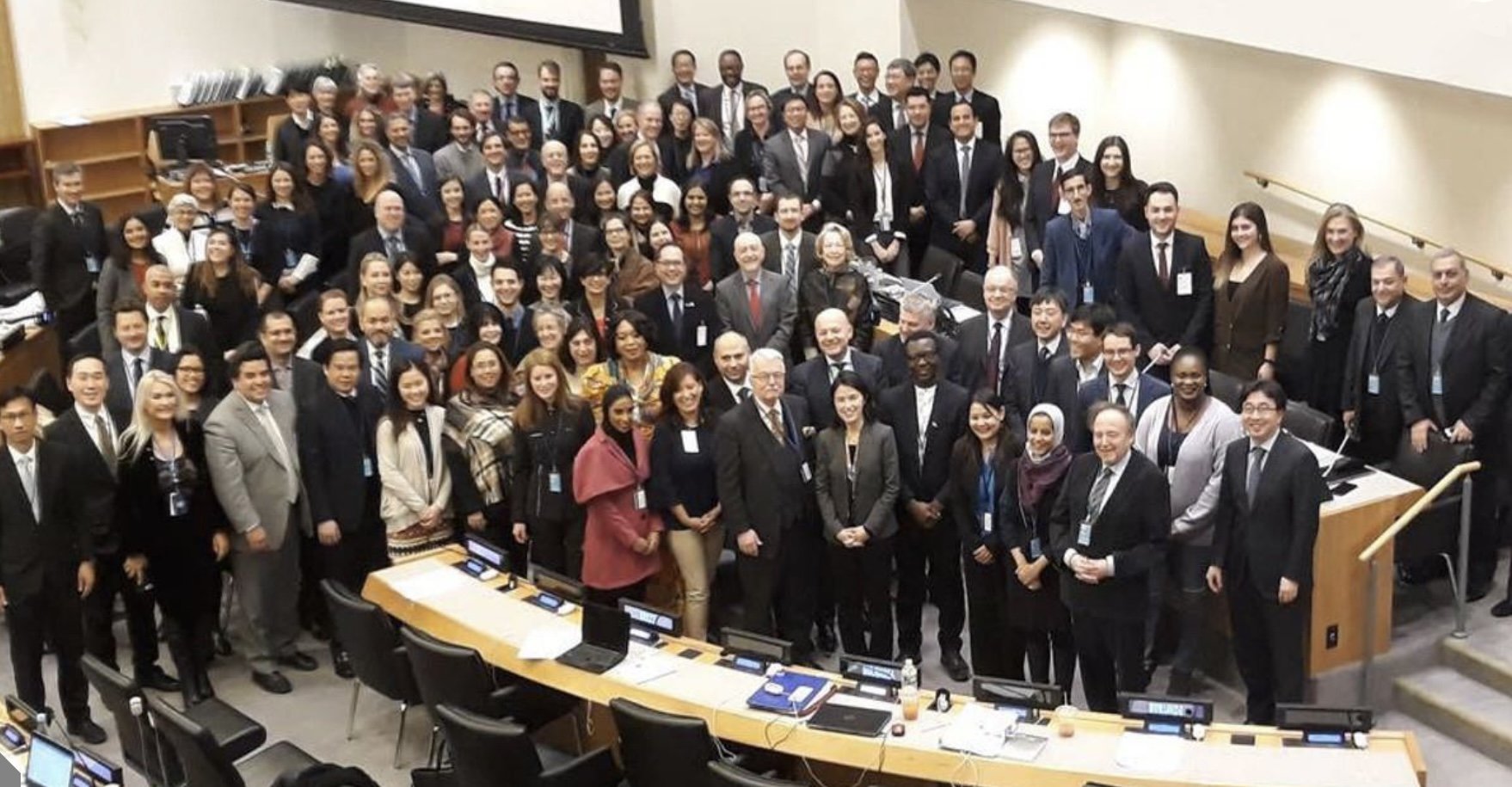
5. Our second common interest is that we both embrace mediation as an important form of dispute resolution - a conciliatory, amicable way of resolving disputes which arise, whether it is between neighbours and the community, or in higher value contracts, or even in big scale investor state disputes. An amicable solution is always preferable. Respecting the sanctity of contracts but still preserving the value of relationships - this was the essence and ethos of the foundation and thinking behind the Convention. Hence, Singapore worked on the Mediation Convention for several years. In fact, if you look at this photograph here, this was the very last day of the Singapore Convention on Mediation (SCM) negotiation that took place at the United Nations (“UN”). You can see the smiling faces, because everyone has signed off on the Convention. That eventually culminated in the Singapore Convention on Mediation that then opened for signing in 2019.
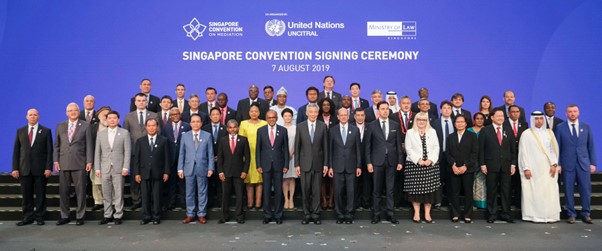
6. Singapore and Fiji were amongst the first to sign the Convention on the very same day in 2019. This photograph was taken in 2019 in Singapore, where we have many countries come together to celebrate the occasion of the opening of the Convention for signing and also, eventually the signing of the Convention.
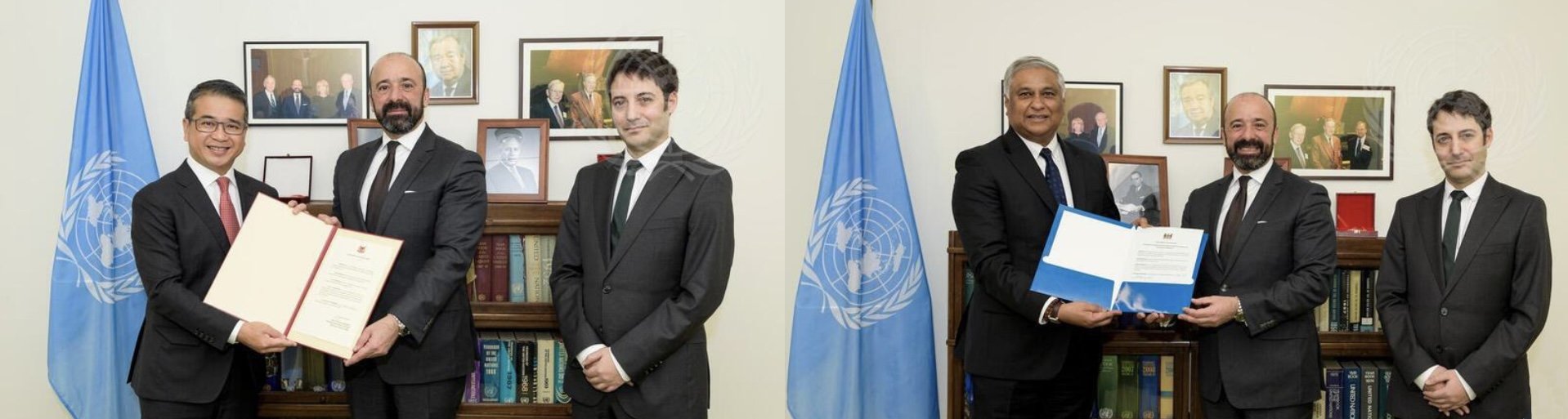
7. The coincidence does not end there, because a few months later, Singapore and Fiji were the first and second countries to ratify the Convention. So not only did we sign it in 2019, but in 2020, we were the first and second countries to ratify the Convention and deposit instrument ratification at the UN in New York. In fact, coincidentally, we arrived on the same day at the UN. We did not know. We did not plan it. We were there on the same day, and that is a photograph of a much younger me on the left, depositing the instrument and the Fijian team on the right. I think it is fair to say that Singapore and Fiji go back a long way in mediation. In fact, as these photographs show, right to the very beginning.
8. It therefore gives me great pleasure and honour to be able to welcome all of you to this event on the Singapore Convention on Mediation today, right here in Fiji. The Convention provides a uniform and efficient framework for the enforcement of international settlement agreements that arise from mediation by parties to a commercial dispute.
9. Since the Convention was adopted in 2018, there has been a strong show of support from countries for the Convention. In fact, the Convention enjoyed the highest number of first-day signatories for a UN Convention.
10. If you take a look at this map here, there were a total of 46 first-day signatories, which have since grown to 59. As you heard from ASG earlier, a substantial number are Commonwealth countries, spread right across the world.
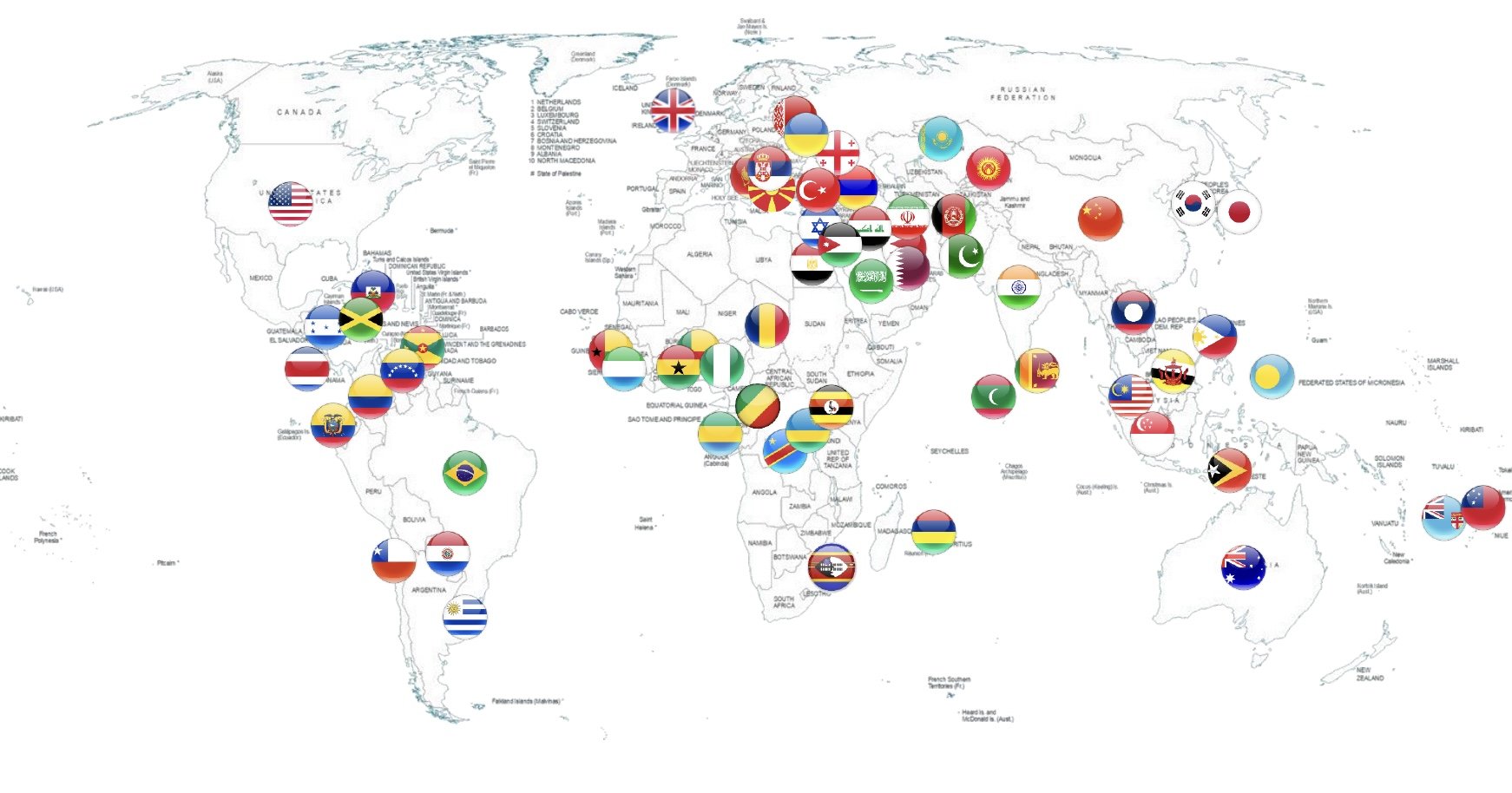
11. I thought to present the information to you in this way, on a map, because it represents diversity; it represents a linkage right across different continents and different legal systems; and it shows you that mediation is universal. The more we are able to have countries and networks like this, expanding it, the more efficient it is likely to be, because as trade partners from different continents, different countries grow, the more we have a connection through the Convention, and the more trade will grow.
12. In fact, from my conversations, just in the last couple of days, right here at the CLMM, I think there are many other countries taking steps, many very advanced or along the way, and I am very encouraged. I think the UK is well on its way. Malaysia has passed legislation. Jamaica is on its way, as well as Rwanda and Pakistan. So, I believe the momentum for this is really growing. In a year’s time, I hope to show you the map again, and hopefully we will have a few more countries on it.
13. Let me briefly touch on two very important features, why we think mediation is important.
14. First, mediation is a driver of trade. It is not just the way of resolving disputes, but it is a driver of trade. Let me explain. Whether it’s trade, investment or cross border transactions, the complexities are growing, and they can trigger disputes between parties and even between states.
15. It will not be a surprise for you to learn that trade and investment, both within the Commonwealth, as well as between Commonwealth and the rest of the world, is in fact, growing.
16. Let me go through this set of slides and make four factual points.
a) First, the Commonwealth attracted nearly one-fifth of all global foreign direct investment ("FDI") flows in 2023 - that was in excess of US$250 billion.
b) Second, FDI flows to the Commonwealth have grown faster than worldwide average since 2015. It is not just 20% but the rate of growth is the fastest anywhere in the world.
c) Third, intra Commonwealth FDI stock has doubled since 2015. Today, the value of that stock is US$1.7 trillion in 2022.
d) Finally, FDI flows between Commonwealth countries reached US$172 billion in 2022. These flows, according to the reports, have more than quadrupled in value since 2015.
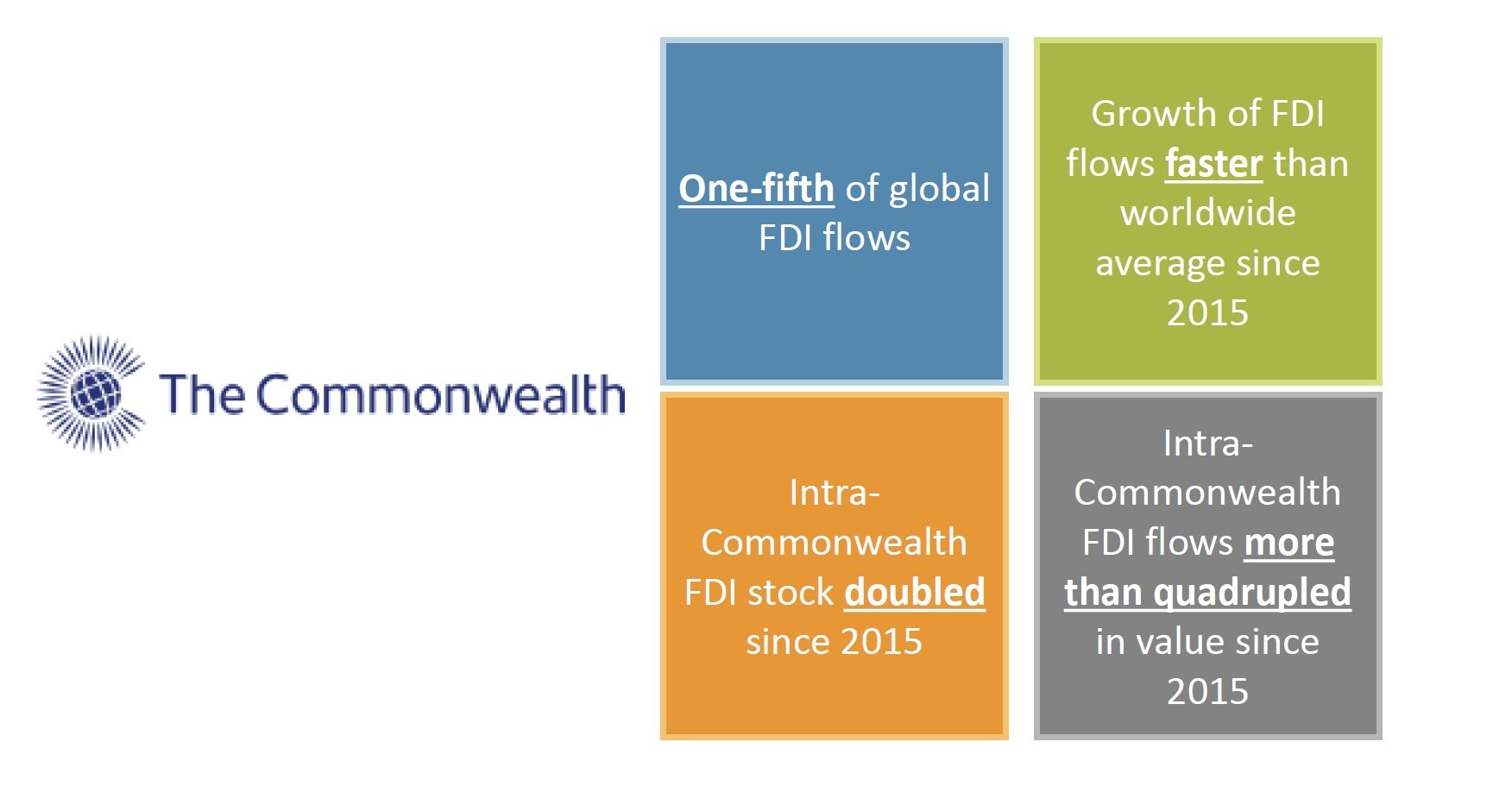
17. Whichever way you look at information, flows coming into Commonwealth, investments in large-scale infrastructure from outside Commonwealth into Commonwealth and even within the Commonwealth, have been growing.
18. All of that is important, but in order for investments to continue to grow, investors must then have confidence that any disputes, should they arise – and we all know invariably they do arise – they must be resolved in a fair, transparent and equitable manner.
19. In this regard, alternative dispute resolution (“ADR”), whether it is through arbitration, conciliation, mediation, provide useful options. There is real value in being able to resolve the disputes amicably through mediation, as you heard ASG say earlier, with the assurance that any agreement arising from mediation can then be enforced across different boundaries internationally.
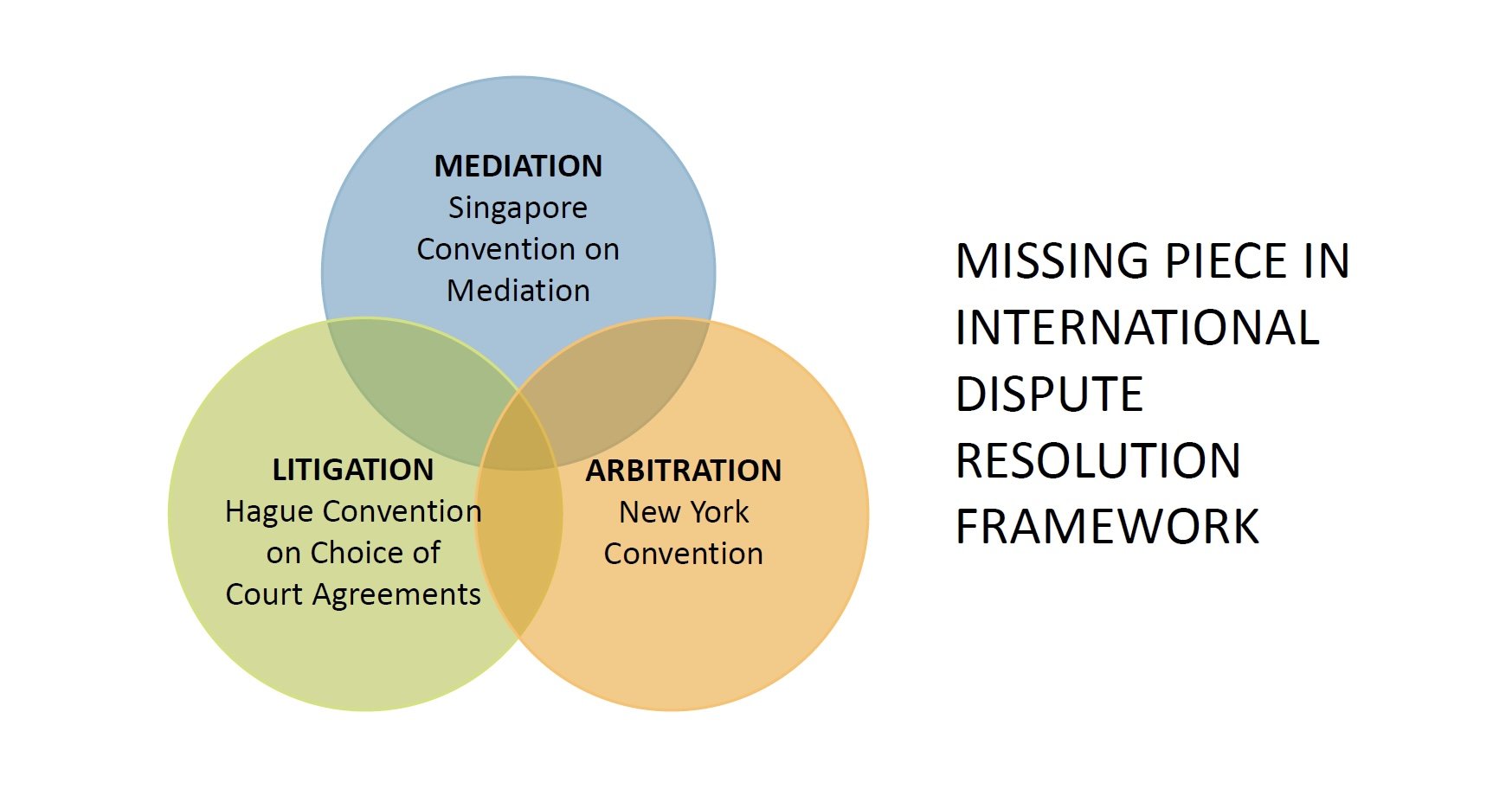
20. It used to be that the starting point was that you end up in court through litigation. You have heard how lengthy those cases can be. Arbitration has also established itself as a key ADR mechanism, because of the growth of enforceability of awards through the New York Convention. The New York Convention started several decades ago, and foreign arbitral awards are now well recognised and enforceable all over the world. In fact, you just compare with the New York Convention when it was opened for signing in 1958, there were 24 original signatories. Today, it boasts about 172 Contracting States. That is a significant growth over the decades, and that, in fact, has powered the growth of our trade.
21. If you take mediation, I believe that a similar and perhaps quicker impact can be had, if the SCM reaches a critical mass in terms of countries who are signed up and ratified. Indeed, mediation has proven to be effective for all the reasons that ASG mentioned. It is recognised as flexible, efficient, cost effective. You can solve a legal problem using extra-legal means. You can find a solution that keeps the parties wedded to one another. You can find a solution that preserves the relationship, and oftentimes, especially in large scale contracts with parties, subcontracting parties and many other subcontractors, the relationship takes much longer to develop and cultivate, and you do not want it to fall apart with one contractual dispute. It enables parties to engage in collaborative, constructive dialogue, to resolve the differences without the adversarial overhang of a litigation or arbitration. ASG shared some war stories earlier – we have had our share of stories as well. Later on, you will hear from Wee Meng, who works at the Singapore International Mediation Centre (“SIMC”).
22. The SIMC has been able to resolve disputes that arbitrations could not. I think it is a similar experience to what ASG has shared earlier. Until now, or at least until the Convention, despite its many advantages – time, speed and cost – mediation faced a critical challenge, and that is the enforceability of cross border settlement agreements. Until the adoption of the SCM, settlement agreements were not automatically enforceable across borders. This is because a mediated agreement, unlike a court judgment or an arbitral award, is only binding contractually between the parties and not directly enforceable in the courts. The lack of an efficient and harmonised framework for cross-border enforcement was often cited as one major impediment or challenge to mediation. The Convention has changed that. In fact, the Singapore Convention is the sister Convention to the New York Convention. What the New York Convention does in arbitration, the Singapore Convention does for mediation – allowing for parties to seek a cross-border enforcement of settlement agreements on time.
23. The second point I will make about why the mediation convention is particularly important, especially in these times, is as follows.
24. Over the last few days, we, as Commonwealth Law Ministers, have discussed important papers, and I think we, by and large, reached consensus on a number of important principles, including multilateralism.
25. I think the one consistent key takeaway that we all had in our discussions has been the erosion of the rule of law - the withdrawal of states from multilateral platforms, from rules-based adjudicatory processes. We have seen news reports almost every day, if not, every other day.
26. For Singapore, however, the rule of law is non-negotiable. It is not so much an aspiration, but rather an existential necessity, underpinning both Singapore’s domestic as well as of foreign policies. Adherence to the rule of law is also equally vital in the international context. An inclusive, rules-based international order is fundamental to peace, security and stability, and it is all the more crucial for states that are heavily dependent on freedom of trade and investment, such as Singapore. It is in this troubled background and climate that our adherence and promotion of the rule of law is of even greater importance.
27. Promoting and adopting a framework like Singapore Convention on Mediation helps to support the growing economic community amongst Commonwealth States, and anchor the conduct of commercial transactions within the rule of law. I believe it will also continue to give confidence to our businesses and to our citizens that we remain committed to a rules-based international order, and that we will continue to seek and facilitate peaceful and effective as well as enforceable means to resolve our disputes and differences, including across different countries. We therefore believe that Commonwealth members have an opportunity in supporting and advocating mediation, and that’s why we decided to host this side event today to speak to our colleagues about mediation, to share our experience in the journey of mediation with all of you.
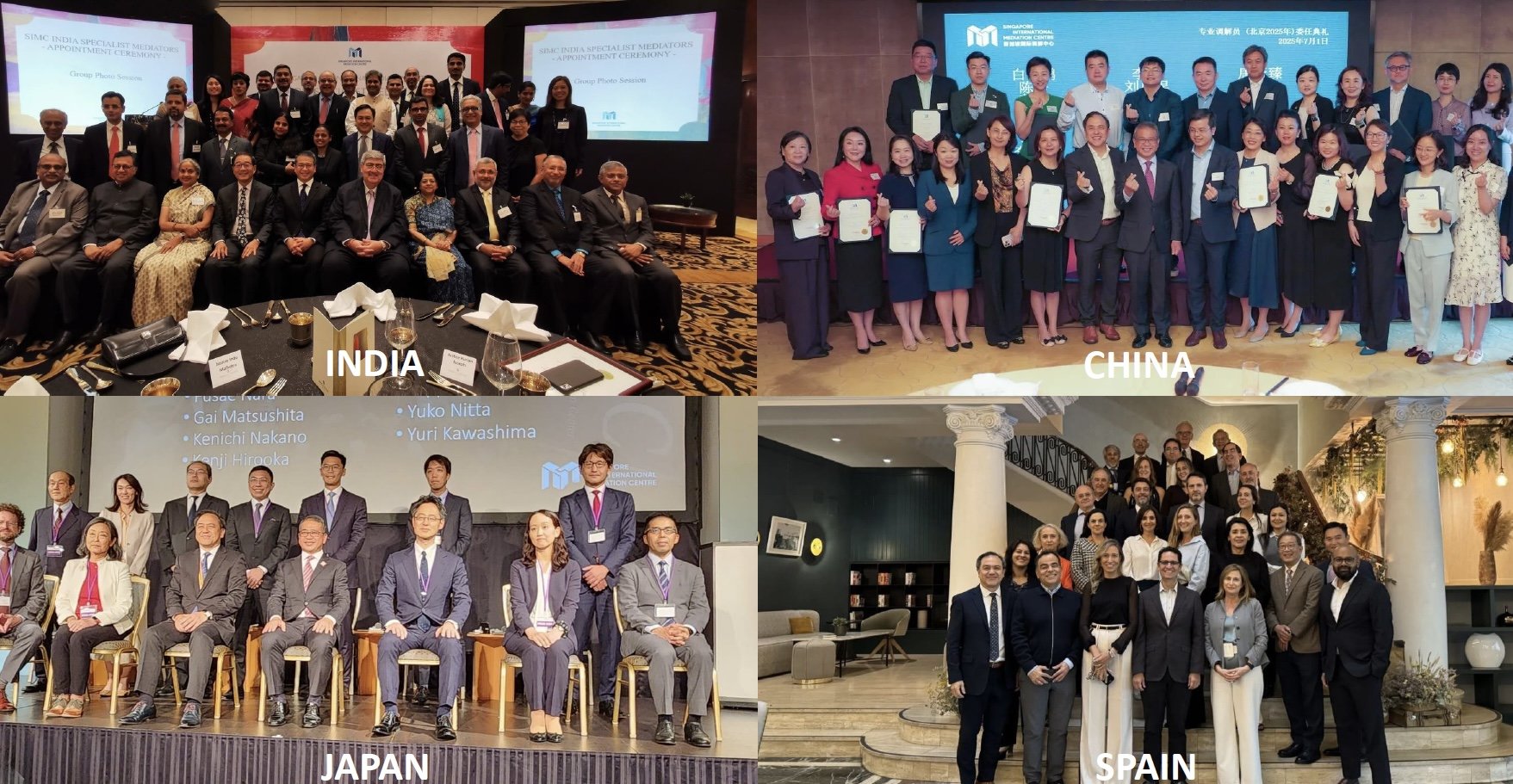
28. In closing, I want to express my sincere hope that the discussions and exchanges that we will have at this event and beyond, will continue to serve as the foundation for our growing collective support for the Singapore Convention on Mediation.
29. In the current landscape of rough seas and strong winds, we must always remember that we are, after all, in the same boat, and I think as Commonwealth colleagues, all the more so. I believe strongly that there is unity in cooperation, because together, we can weather the storms and find calmer waters to reaffirm our shared belief in the rule of law.
30. There is an African proverb, which I like to use because it resonates with me. It is broadly translated into “to go fast, you go alone, but to go far, we go together”. That is why I believe that in the spirit of going together, coming together like this, to discuss our views on mediation, to look at different ways in which we can advance it, is very helpful.
31. In is an African proverb, which I like to use because it resonates with me. It is broadly translated into “to go fast, you go alone, but to go far, we go together”. That is why I believe that in the spirit of going together, coming together like this, to discuss our views on mediation, to look at different ways in which we can advance it, is very helpful.
32. Over time, that has grown into an event that saw more than 60 partner organisations interested in the ADR space, join us on this important global dialogue. In fact, more than 5,000 attendees from over 100 jurisdictions joined us last year in Singapore. We believe that the Singapore Convention offers a timely and innovative solution to problems that we face in international dispute resolution.
33. Let me warmly welcome each of you to be in Singapore to take part in the Singapore Convention Week 2026, and if you like more details, scan the QR code. This, I promise you, will be my only plug for the afternoon.
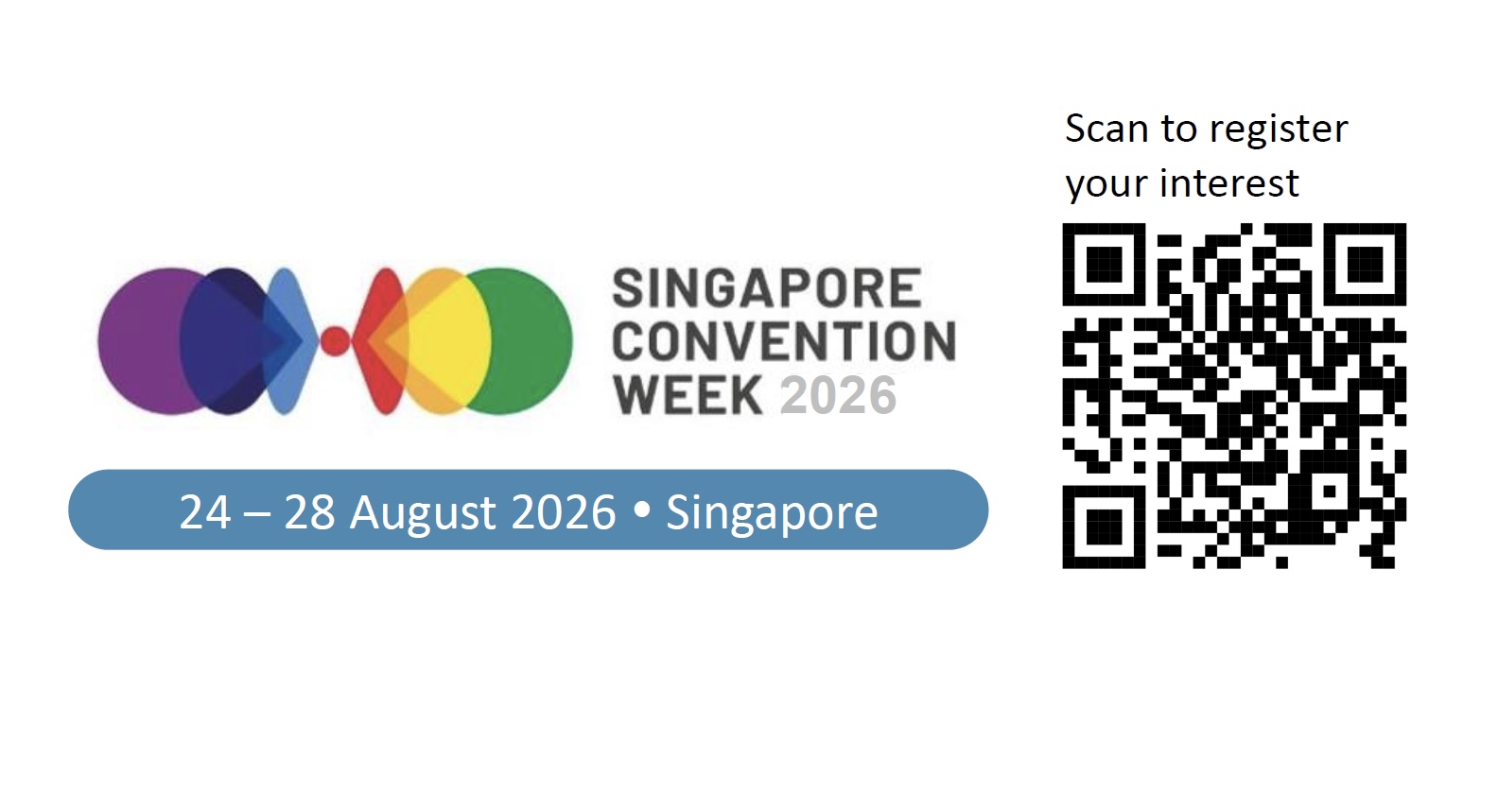
34. We are expecting another bumper crop, because we are celebrating a number of things in Singapore, including what we call the bicentennial year. It has been 200 years since we received the Second Charter of Justice. The Second Charter of Justice is now the backbone of our legal system. Our justice system was inherited from the Second Charter of Justice, although, of course, we have contextualised it. We will commemorate the occasion in 2026 as the 200th year from which we have inherited the Second Charter of Justice.
35. With that, I wish all of you are very fruitful event ahead. We will be hearing from Wee Meng from the SIMC, who will share with you some technical details about mediation, and then we will have a short dialogue session where it is open to any of you to ask us questions on mediation –how to go about ratifying the SCM, what do we need to do to train mediators, or perhaps, how do we see the mediation landscape for the possible future, or any questions that you might have on mediation.
36. With that, I wish you a very, very pleasant afternoon, and thank you once again for being here and joining us for this event.
37. Thank you.
Last updated on 12 February 2026