

Speech by Minister for Law and Second Minister for Home Affairs, Edwin Tong SC, at SIAC Annual Appreciation Event
Mr Davinder Singh SC, Chairman of SIAC Board
Ms Lucy Reed, President of SIAC Court
Ms Gloria Lim, CEO of SIAC
All the Board and Court Members, as well as SIAC staff
Honourable Judges
Friends, Colleagues
Distinguished Guests
Ladies and Gentlemen
Introduction
1. Good evening.
2. I am so delighted to join you here this evening, to celebrate SIAC’s 35th anniversary, and also to be with SIAC to thank all of you – its partners, supporters, and friends.
SIAC’s Achievements
3. 35 years sounds like a long time to some of us, but in the history of international arbitration, it is but a mere heartbeat. Modern international arbitration is often traced back to the Jay Treaty, signed in 1794, or more than 230 years ago, and the oldest arbitral institution in the world dates back to more than 130 years.
4. Yet, in just three and a half short decades, SIAC has achieved remarkable growth. It has grown into one of the world’s leading arbitral institutions. Its caseload has grown from just two cases in 1991 to more than 600 in 2024 – and like Gloria, I will leave you in suspense about what happens thereafter.
5. Its reach now spans continents, and SIAC will continue to deepen its connection with users in key markets globally. They will take further steps to increasing its presence in new locations, and will announce the opening of new offices later this year. Its standing in global rankings, in the eyes of practitioners, continue to rise.
6. SIAC has also become a thought leader globally – through innovations, such as those you saw on the screen earlier, which Gloria showed.
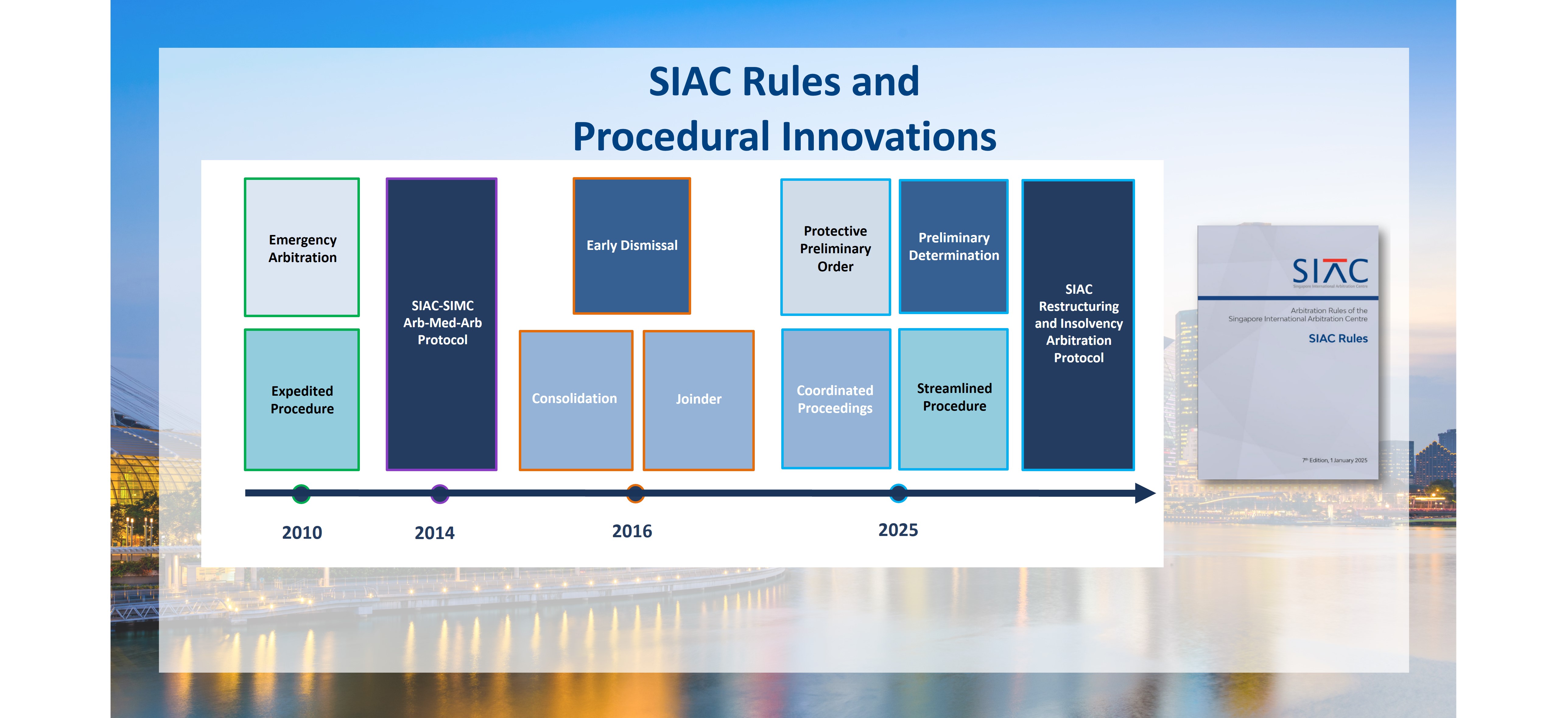 Later this month, its Rules will be applied for the first time in both Vis Moot in Vienna and Vis East Moot in Hong Kong. In fact, just last week and yesterday, I met with the Singapore Vis Moot teams from both NUS and SMU Law, where I highlighted the significance of this development. I think it’s a very good recognition, not just for SIAC but for the users of SIAC, and for its future. I told the students that it’s a privilege that they get to compete in these moots, and that using these rules is a clear testament to our standing among the best in the field.
7. So today, the name SIAC carries weight in many corners of the world. It inspires trust, instils confidence, and you heard earlier, and it also stands as a beacon of excellence in international arbitration.
Thank SIAC
8. This journey, however, has not been easy. I think past and present Board and Court members, and SIAC staff, will attest to that.
9. SIAC has never been content to rest on its laurels. It has always been looking ahead, always striving for the next challenge, and looking for the next stage of growth. What more can we do? How can we serve our users better? And what do we need to do to stay ahead of the competition?
10. Even today, when SIAC is a global leader, the pursuit of excellence continues. I know Davinder, Lucy, Gloria, Vivek (Registrar of SIAC) and the entire SIAC team would be the first to tell you that work is never done.
11. This appreciation event is organised by SIAC to thank all of you. But I think most of us would agree that the people of SIAC themselves deserve our deepest thanks as well.
12. We are immensely grateful to the SIAC leadership and the team – past and present over the past 35 years – who have devoted their time and energy to building up this institution. There are far too many to name individually but please know that each of you is deeply appreciated, and your contributions deserve recognition.
13. Many have invested enormous time and effort – personal time and personal effort – to bring SIAC to where it is today.
(1) Davinder – widely acknowledged as Singapore’s leading litigator – spends an inordinate amount of time thinking about SIAC, discussing what more we can do, and thinking about the challenges ahead of us.
(2) Board and Court members serve without remuneration. Court members in particular, agree to be appointed, fully aware that SIAC will not be able to appoint them to cases, so as to avoid any perception of conflicts. There is therefore real sacrifice behind each individual who put in so much to build up SIAC.
(3) And I told Lucy just now, I cannot remember which continent we were last in when we last met. She works tirelessly during and after office hours and on weekends, and goes off whenever and wherever she is needed and we are especially grateful, Lucy.
14. But despite the fact that we built up an institution that is SIAC, supported by our first-class judiciary and by the government, I think institutions do not succeed just because of buildings or rules. They succeed because of individuals and the people behind it – people who believe in what they are building, and SIAC has indeed been fortunate to have had many of such people.
Challenges Ahead
15. The past 35 years have not been easy, but I think the next 35 years could be even more challenging. Very often, it is easier to catch up when you are behind, when you are the challenger, trying to catch up, when you are the newer kid on the block, trying to catch up with those who get more established. But it is much harder to stay ahead once you are in the lead.
16. I shared this at the event organised by my Ministry last Friday, titled “The Next Charter: Shaping Singapore’s Legal Future Together” and I thought I will just share a few of my points with you.
17. I think we all agree that competition is intensifying – not just for SIAC, but for Singapore in general, as an international commercial dispute resolution hub, arbitration included. Other jurisdictions are strengthening their arbitration frameworks and many are reforming their laws fundamentally to deal with the cases that would come ahead, and to meet competition like SIAC and other places head on.
18. Arbitral institutions are also updating their rules and expanding overseas. Across Asia, cities such as Beijing, Shanghai, Shenzhen, Guangzhou and Dubai, are steadily climbing the rankings. Many are also building integrated dispute resolution facilities, similar to Maxwell Chambers. So, the landscape is becoming a lot more competitive.
19. But at the same time, I remain optimistic as I look ahead to the next 35 years and beyond, because while rules and laws can be copied, trust cannot. Confidence has to be earned, and it takes time to earn trust and confidence. And in today’s uncertain world, trust is both more important, as well as increasingly scarce. Recent studies illustrate this clearly.
(1) The 2026 Edelman Trust Barometer speaks of a growing “crisis of grievance” and rising insularity across societies.
(2) Around 70% of the respondents say they are either unwilling or hesitant to trust someone with different values, perspectives, or backgrounds.
20. Trust takes years, as I said, often decades to build. It requires consistency, credibility, and integrity, not one-off, but over time, and Singapore and SIAC have spent many years building precisely that.
Singapore’s Foundations
21. This year, Singapore also marks the bicentennial of the Second Charter of Justice, which formally established the Court of Judicature, and introduced English common law to Singapore.
22. Over the past two centuries, we have carefully developed and adapted it. We have contextualised the legal system we inherited – moulding it, shaping it, making sure it is fit for purpose for Singapore and Singaporeans.
23. Today, by many international measures, Singapore has a trusted legal system. Whether you look at the work of the World Justice Project, Pew Research Center, or Gallup, Singapore consistently performs strongly in areas, such as order and security, absence of corruption, regulatory enforcement, the civil justice system, and the criminal justice system.
24. These strengths, nurtured and built up over time, have allowed Singapore to grow into a trusted professional services hub, with legal services playing a central role. And within that ecosystem, arbitration has become one of Singapore’s defining strengths.
Government’s Commitment
25. My Ministry is committed to strengthening this ecosystem even more.
(1) As you heard from Davinder earlier, we regularly update our legislation to keep pace with global developments and best practices. Indeed, if you look at our legislative history of the International Arbitration Act, in a short space of about 30 years, it has been amended 17 times. So almost once every two years, we are in Parliament, looking at evolving, changing, suiting the business needs of our users, to ensure that we are fit for purpose, we evolve with the times and that we remain relevant.
(2) We build international partnerships to strengthen legal and dispute resolution cooperation.
(3) We promote Singapore’s legal and dispute resolution services overseas, and we host international events to bring the global legal community right here in Singapore. You learn about the Singapore Convention Week, and it is happening again this year from 24 to 28 August. So, mark that down in your calendar!
26. Our goal ultimately is to create the best legal environment for work to be done in Singapore, and for disputes to be resolved here.
27. But ultimately, our role is a supporting one. We aim as a government to simply to provide the strongest possible foundation upon which institutions like SIAC can continue to thrive in Singapore.
Singapore’s Strengths
28. I always say that one of Singapore’s greatest strengths is how the government, the bench, the bar, the academia, law schools as well as our institutions can come together, work closely together collectively to advance our common interests for Singapore. We do not work in isolation, but instead, we work together to advance Singapore’s core interests. This collaboration extends beyond Singaporeans and residents. It includes many talented individuals from around the world who today call Singapore home, such as everyone in this room today.
29. If any of you have ideas or suggestions on what more we can do, how else we can amend our legislation, what else can we do to our rules, how else can we drive users to Singapore, either practising in Singapore or from Singapore, or even through Singapore, let us know. We would be very happy to take on the feedback. All of you, ultimately, are more closely connected and plugged in to the end users, so if you share your views with us, I think collectively we can build a much stronger ecosystem.
Conclusion
30. But as I end, let me start where I began – with SIAC.
31. 35 years ago, SIAC started as an ambitious idea – that Singapore could be a trusted, neutral venue with strong governance anchored by the rule of law, where international parties could resolve their disputes.
32. Today, three and a half decades on, that idea has become a reality.
33. And if the past 35 years are anything of an indication, I have every confidence that SIAC will continue to grow, to innovate, and to lead.
34. So tonight, I think we should celebrate not just the achievements of the past, but also, the promise of the future.
35. Once again, my warmest congratulations to SIAC and the entire team of SIAC on your 35th anniversary and thank you to all of you- past, present, and if I dare say, the future as well, for being a part of this remarkable journey.
36. I look forward to catching up with some of you, but I will have to take my leave a little earlier tonight as I will be catching a flight today.
37. On that note, happy 35th anniversary and thank you very much for having me at your event this evening.
Last updated on 10 March 2026